
Bacalar Real Estate: Lagoon Investment Guide for 2026
Bacalar lagoon real estate investment, Lake of Seven Colors, $150K-500K eco-properties, emerging market, patient capital required, honest 2026 analysis.
By Mexico Invest Editorial · Updated July 9, 2026 · 14 min read
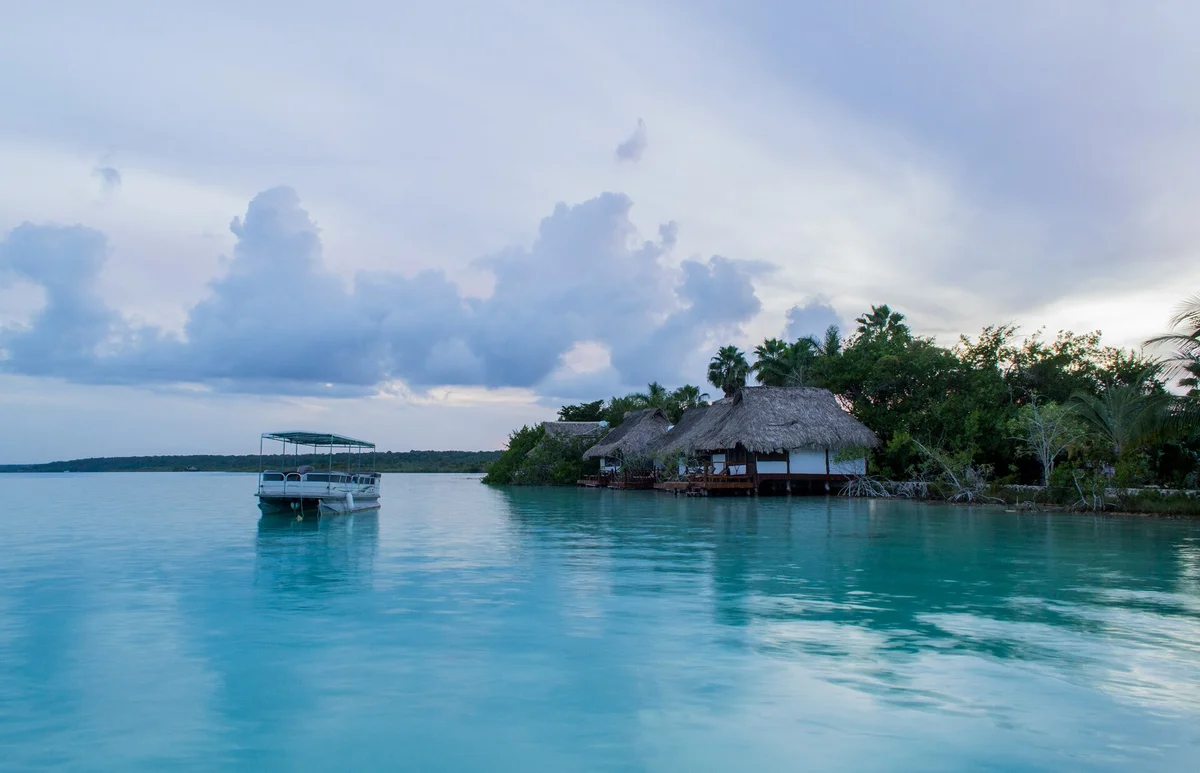
Quick answer: Bacalar is Mexico’s emerging eco-tourism lagoon investment with striking Lake of Seven Colors imagery, $150K-500K property range, and estimated 3.0-4.5% net yields, but infrastructure gaps, 3.5-hour distance from Cancun airport, and thin buyer pool demand patient capital and long hold horizons rather than near-term yield expectations.
Bacalar sits at the far south of Quintana Roo, 330km from Cancun, where a 57km-long freshwater lagoon with extraordinary colour gradation from turquoise to midnight blue has attracted growing international attention since roughly 2018 as Instagram and social media discovered the destination.
Regional context: Riviera Maya Property Investment Guide. Compare capital: Merida Real Estate.
Bacalar overview: what makes the lagoon unique
Bacalar Lagoon’s visual distinctiveness is not marketing hyperbole. The water colour variation, caused by varying water depth above white sand and limestone reflecting different wavelengths of light, creates genuinely extraordinary imagery that has driven millions of social media posts and attracted a rapidly growing independent travel circuit.
| Lagoon metric | Detail |
|---|---|
| Length | 57km |
| Maximum depth | Approximately 40m |
| Water colour range | Turquoise to midnight blue in transition |
| Status | Ramsar protected wetland |
| Distance from Cancun | 330km, 3.5-4 hours via Highway 307 |
| Distance from Tulum | 130km, 1.5 hours |
| Airport | Chetumal (CTM) 65km south, limited service |
| Nearest major airport | Cancun (CUN), 3.5 hours |
The lagoon’s protected status under Ramsar convention means development is structurally constrained, a positive supply-side factor for long-term investors, but also a compliance complexity for any buyer planning construction.
Property types and pricing
Bacalar has three products and they behave differently. A lagoon-front lot at $150,000-280,000 is a development project with permitting risk, not an asset. A basic eco-residence at $195,000-320,000 rents but rarely well. The developed eco-house with a permitted dock at $320,000-500,000 is the only category with a working yield case, and the dock concession is most of the reason.
Bacalar’s real estate market is smaller and less formalised than Riviera Maya coastal markets. Inventory categories are loosely defined:
| Property type | Price range | Investment notes |
|---|---|---|
| Lagoon-front lot | $150K-280K | Requires development; compliance risk |
| Basic eco-residence | $195K-320K | Simple construction, lagoon proximity |
| Developed eco-house with dock | $320K-500K | Best yield positioning |
| Hotel boutique unit | $250K-420K | Managed program if available |
| Inland residential property | $120K-220K | Lower pricing, no lagoon views |
Prices have increased 80-120% from 2019 to 2026 in the lagoon-front segment as Tulum-overflow interest discovered Bacalar. The price increase has not been matched by proportional development of management infrastructure, creating a gap between aspiration yields and operational reality.
Why Bacalar is genuinely emerging, not yet established
Two numbers separate Bacalar from an established market: a 3.5-hour transfer from Cancún against 45 minutes to Playa del Carmen, and four to six small management operators against forty-plus. Add satellite internet in many properties and the picture is clear; this is a market where the operational infrastructure a rental business depends on has not arrived yet.
The critical distinction between Bacalar and established markets like Playa del Carmen, Puerto Aventuras, or even Tulum is infrastructure maturity for STR operations:
| Factor | Bacalar | Playa del Carmen |
|---|---|---|
| Internet quality | Basic, satellite for many properties | Fibre broadly available |
| Management companies | 4-6 small operators | 40+ established operators |
| Guest transport from airport | 3.5 hour transfer from CUN | 45 min from CUN |
| Commercial services | Limited town centre | Full urban services |
| Medical facilities | Basic clinic, hospital in Chetumal | Hospital in Playa |
| Resale comparable data | Very limited | Well-established |
The infrastructure gap means management quality for STR operations is materially less consistent than in established Riviera Maya markets. Guests arriving at a poorly-maintained eco-property after a 4-hour transfer from Cancun are not forgiving reviewers.
The developer model against a realistic one
The developer model for a $350,000 lagoon-front eco-residence assumes 65% occupancy at a $200 ADR, figures drawn from Tulum, three and a half hours away, not from Bacalar. Rebuild it at the occupancy this market actually delivers and the result moves by more than a full percentage point of net.
Borrowed comparables are the specific defect in Bacalar pro formas. A 65% occupancy at a $200 ADR describes Tulum, three and a half hours north with its own airport and an established manager ecosystem, not a lagoon town whose visitor base arrives by road. Rebuilt at 50% occupancy the same $350,000 residence loses roughly $10,950 of gross while $12,622 of fixed costs stays put, taking net from 5.9% toward the low fours. Ask any developer which market their occupancy figure came from, and for 12 months of operating statements from a comparable Bacalar unit rather than a regional average.
Optimistic developer model (lagoon-front eco-residence, $350K):
| Component | Annual USD |
|---|---|
| Gross revenue (65% occ., $200 ADR) | $47,450 |
| Management (30%) | -$14,235 |
| HOA / maintenance | -$3,600 |
| Utilities (generator, water, internet) | -$3,200 |
| Maintenance reserve (7% coastal-eco) | -$3,322 |
| Insurance | -$1,800 |
| Fideicomiso fee | -$700 |
| Net | $20,593 |
| Net yield | 5.9% |
Every figure in this column is a projection at good conditions supplied by the sales side, not measured revenue. Bacalar has no established operating record to test it against, and the implied gross runs well above the 5.5% to 7% full-year average reported elsewhere in the region. The realistic model below is the one to plan against.
Realistic model (50% occupancy, 2026 infrastructure reality):
| Component | Annual USD |
|---|---|
| Gross revenue (50% occ., $175 ADR) | $31,938 |
| Management (30%) | -$9,581 |
| Fixed costs | -$12,622 |
| Net | $9,735 |
| Net yield | 2.8% |
Established operator model (documented repeat-guest base):
| Net at 58% occ., $190 ADR | ~$15,000 net |
|---|---|
| Net yield | 4.3% |
The honest range of 3.0-4.5% reflects Bacalar’s operational reality. The upper end is achievable for properties with established management, repeat guest bases, and reliable infrastructure. Most buyers purchasing in 2025-2026 will spend 12-18 months building to that level rather than starting there.
Bacalar as an appreciation play
If Bacalar works, it works on capital appreciation rather than yield, and the case rests on supply: Ramsar protection and SEMARNAT setbacks cap how much can ever be built on the lagoon. Against that sit rising visibility since 2018, road improvements that cut roughly 30 minutes off the CUN transfer, and travellers priced out of Tulum. It is a thesis, not a track record.
Appreciation is the honest thesis here and it should be underwritten as one. At 50% occupancy a $350,000 lagoon-front residence produces income in the low four percents while carrying generator-dependent utilities, a 7% maintenance reserve for the eco-build, and a resale market measured in a handful of transactions a year. A buyer taking that position is betting on Bacalar becoming what Tulum was in 2015, over a hold measured in a decade rather than years, and should size the position as speculative capital rather than as a yield holding.
Where Bacalar may outperform on a total return basis, income yield plus appreciation, is in capital appreciation as the destination matures.
Factors supporting appreciation thesis:
- Social media visibility increasing year-on-year since 2018
- Tulum becoming overpriced for some travellers who are discovering Bacalar as alternative
- Limited supply by environmental protection
- New road improvements reducing CUN-to-Bacalar transfer time by approximately 30 minutes since 2023
- Growing eco-resort pipeline attracting more professional guest infrastructure
Appreciation risk factors:
- Tourism trends change: What Instagram discovers, Instagram can also abandon
- Infrastructure investment may not materialise on anticipated timelines
- Environmental enforcement could restrict further development
- Economic downturn reducing discretionary eco-tourism budgets
| Scenario | 5-year appreciation |
|---|---|
| Infrastructure improves on schedule | 35-50% price appreciation |
| Stagnant infrastructure | 10-20% appreciation |
| Major tourism trend shift away | Flat or below-purchase |
Pros and cons for investors
The trade is unusually clean: a genuinely unique setting with federally capped supply, against a 3.5-hour airport transfer, immature management, a thin buyer pool and resale periods beyond 200 days. If you need income within two years, the cons decide it. If you are buying a scarce asset for a decade, the pros might.
| Pros | Cons |
|---|---|
| Unique visually extraordinary lagoon setting | 3.5 hours from Cancun airport limits short-break market |
| Federal protection limiting future supply | Emerging management infrastructure, inconsistent quality |
| Growing social media and eco-tourism visibility | Thin buyer pool, resale can be slow (200+ days) |
| Prices still below Tulum equivalents for similar eco-character | Yield data thin, most models are estimates not verified data |
| Multiple appreciation catalysts on the horizon | Ramsar compliance for any construction adds cost and delay |
| Strong lifestyle value for personal-use buyers | Hurricane season still reaches this far south |
Bacalar is appropriate for patient capital investors comfortable with frontier market risk. It is not appropriate for investors seeking liquidity, yield certainty, or 3-year exit strategies.
Environmental and regulatory complexity
Bacalar’s Ramsar wetland status means three separate authorities can stop you building: SEMARNAT enforces setbacks stricter than standard coastal rules, CONAGUA controls every dock and water access concession, and Mexico’s international Ramsar obligations require an environmental report for construction. A structure or dock without those papers is a liability that transfers with the property.
Bacalar’s Ramsar wetland designation adds layers of regulatory complexity beyond standard coastal Mexico:
| Regulation | Application | Implication |
|---|---|---|
| SEMARNAT setbacks | Stricter than standard coastal | Larger minimum lot for buildable area |
| CONAGUA | Dock and water access permits | Required for any dock installation |
| Ramsar obligations | Mexico bound internationally | Environmental report required for construction |
| Municipal zoning | Bacalar town limits STR density | Commercial STR may require municipal license |
| FONATUR (Mayan Train) | Route passes nearby | Potential future access improvement |
The Mayan Train railway (Tren Maya) has a station in Chetumal, 65km south of Bacalar. As Tren Maya usage grows, Bacalar may benefit from train-accessible eco-tourism from Tulum and Playa del Carmen, a positive medium-term catalyst.
What checklist should run before you sign?
Six checks, four of which do not exist in any other Mexican market: lagoon setback compliance, the dock concession, water quality on your own stretch of shoreline, and a realistic internet speed test taken at the property during working hours rather than in a developer demonstration. The last two decide whether the property can host a remote-working guest at all.
- SEMARNAT compliance for any existing structure: Verify construction permits are current and compliant with lagoon setback requirements
- CONAGUA dock permit: If any dock exists, verify it holds a valid concession
- Water quality testing: Test the specific area of lagoon adjacent to the property, water quality varies significantly by location and upslope development
- Internet service realistic speed test: Conduct a speed test at the property during business hours, not developer demonstration
- Comparable sales data: Request all completed sales in the last 24 months in the specific neighbourhood
- Flood risk assessment: Some Bacalar properties have seasonal flooding risk from the lagoon level rising in heavy rain
- Title chain verification: Some Bacalar rural properties have complex ejido or heritage land histories requiring specialist review
- Mayan Train access impact: Research current Tren Maya station proximity and projected schedule for future service improvements
What our field notes show for this market
The pattern across Q1-Q2 2026 site visits is consistent: buyers who came for the lagoon are satisfied, and buyers who came for the yield are not. Best documented net yield was 4.3%, on a lagoon-front property with established management and three years of operating history, the profile that barely exists in current inventory.
Observations from site visits and investor consultations, Q1-Q2 2026.
| Observation | Detail |
|---|---|
| Buyer profile split | 55% appreciation/lifestyle, 45% yield-focused |
| Yield-focused buyer satisfaction | Lower than appreciation/lifestyle buyers |
| Best documented net yield | 4.3% (lagoon-front, established management, 3 years operating) |
| Management infrastructure gap | Significant, fewer than 6 professional operators |
| Average resale DOM | 200-280 days |
| Most common buyer mistake | Projecting Tulum STR metrics onto Bacalar |
| Most common title risk | Adjacent ejido land complications |
| Tren Maya impact assessment | Modest positive within 3-5 years if service increases |
Our brokerage advises buyers to allocate no more than 20-25% of total Mexico real estate portfolio to Bacalar given the frontier market risk profile. It is a diversifying holding within a broader portfolio, not a primary yield investment.
Buyer scenarios
Bacalar rewards one kind of buyer and punishes two others, and the difference is entirely about time horizon. The market is early: prices are low relative to the Riviera Maya, yields are correspondingly thin at 3.0-4.5% while the destination matures, and the buyer pool for resale is small. That combination works for an investor with seven to ten years and an appetite for the lagoon’s appreciation case, and for a lifestyle buyer who wants a personal base with managed income between visits. It works badly for anyone with a three-year exit plan, and worse for anyone comparing raw yield against Playa’s data-verified 4.3-5.2%.
Scenario A, Eco-appreciation thesis, $280K: An investor with a 7-10 year horizon, comfortable accepting 3.0-3.5% yield in early years while the destination matures, and genuinely excited by the lagoon’s beauty and eco-tourism trajectory. This buyer’s total return thesis combines moderate income yield with meaningful appreciation potential. The holding period is the key variable, patience is genuinely required.
Scenario B, Lifestyle base with income, $350K: A buyer who has visited Bacalar, loves the lagoon and community character, and wants a personal base for 6-8 weeks annually with managed income the remainder of the year. This buyer evaluates the investment partly on lifestyle terms. The eco-retreat access and lagoon connection provide personal value that supplements the financial return.
Scenario C, Wrong buyer: 3-year exit plan: Any investor planning to purchase and resell within 36 months faces thin buyer pool, limited comparable sales, and a market that has not had time to absorb recent price increases. The exit timeline does not align with Bacalar’s market maturity trajectory.
Scenario D, Wrong buyer: yield comparison with Playa del Carmen: An investor comparing Bacalar’s estimated 3.0-4.5% yield against Playa del Carmen’s data-verified 4.3-5.2% yield should choose Playa del Carmen unless Bacalar’s specific characteristics are valued independently. The risk-adjusted return comparison does not favour Bacalar over established markets.
Comparison: Bacalar vs other eco-investment options
| Factor | Bacalar | Tulum Holistika | Tankah Bay |
|---|---|---|---|
| Distance from CUN | 3.5 hours | 1.5 hours | 1.5 hours |
| Unique experience | Lake of Seven Colors | Cenote eco-resort | Ocean-cenote mix |
| Management infrastructure | Frontier | Established resort | Very limited |
| Yield (estimated net) | 3.0-4.5% | 2.1-3.5% | 3.5-5.0% |
| Buyer pool (resale) | Small | Niche | Tiny |
| Appreciation upside | High (emerging) | Limited (mature) | Moderate |
The three eco-tourism options below sit at different points on a single trade between growth and friction, and Bacalar is at the far end of it. Three and a half hours from Cancún airport against ninety minutes for the Tulum alternatives, with management infrastructure the table honestly labels frontier rather than developing. What Bacalar has that neither comparable can replicate is the Lake of Seven Colors itself, a genuinely unique asset with binding environmental protection limiting how much can ever be built around it. Investors who prioritise smooth operations choose Tulum; investors who prioritise future growth accept the current limitations knowingly.
Ownership and legal framework
Bacalar sits about 50 km from the Belize border, which puts it inside the 100 km border restriction, so a fideicomiso is required even on parcels that are nowhere near the coast. Buyers who assume inland means direct title get this wrong, and it is a $2,500-4,000 surprise plus $500-800 a year.
Foreign buyers in Bacalar have two ownership options depending on location:
| Option | When applicable | Cost |
|---|---|---|
| Fideicomiso | Within 100km of border (Belize border nearby) or 50km of coast | $2,500-4,000 setup + $500-800/year |
| Mexican corporation (SA de CV) | As alternative for some non-coastal inland parcels | Higher setup, ongoing compliance |
Bacalar’s proximity to the Belize border (approximately 50km) activates the 100km border restriction rule that requires fideicomiso even for technically non-coastal properties. Consult a notario for the specific parcel’s classification.
Due diligence checklist for Bacalar
Six documents to obtain before any deposit, in this order of consequence: SEMARNAT compliance and the CONAGUA concession, because they cannot be cured after purchase; the ejido-free title chain; then water quality, flood history and a real internet speed test, which determine whether the property is rentable.
- SEMARNAT compliance documentation for any existing structure
- CONAGUA dock/water access concession if applicable
- Title chain verified from ejido-free origin
- Water quality testing conducted by independent laboratory
- Flood level history reviewed for specific parcel
- Internet speed tested on-site during business hours
- Comparable sales data reviewed (expect very limited)
- Mayan Train station access and schedule researched
- Ramsar zone impact assessment for any planned construction
- Medical facilities and emergency services mapped from property
Due Diligence Mexico Real Estate
Bacalar yield data is estimated from limited transactions due to thin market volume. All figures require independent verification. This is a frontier market and all associated risks should be fully understood before committing capital. Mexico Invest provides editorial analysis only.
Bacalar project reviews
Two Bacalar projects have been through our review process, and their main value is as a reference point rather than as recommendations. In a market this thin there is no reliable comparable-sales data to price against, a handful of listings, few completed transactions with published figures, and no index worth citing. Reviewed projects at least establish what current inventory looks like, what developers are asking, and what programme terms are being offered. Read them as evidence about the market’s present state rather than as a shortlist, and price any Bacalar purchase against the specific parcel rather than against a corridor average that does not yet exist.
Bacalar Lagoon Homes and Bacalar Mia Suites are projects we have reviewed in this corridor.
Buyer scenarios and decision framework
Read every profile here as an appreciation position rather than an income one. At a realistic 50% occupancy a $350,000 lagoon-front residence produces income in the low four percents while carrying generator-dependent utilities and a 7% maintenance reserve, against a resale market measured in a handful of transactions a year.
| Profile | Typical budget | What to verify first | Realistic outcome |
|---|---|---|---|
| US cash buyer | $200K-$400K | Fideicomiso quote, HOA STR rules, escrow wire path | 30-90 day resale closing in Quintana Roo |
| Canadian investor | $250K-$500K | SAT rental registration, PM fee band 25-35% | Net yield often 3-5% after HOA and management |
| Remote closer | Any | Apostille/POA chain, notario timeline, FX policy | Closing without travel if documents are clean |
| Yield-focused buyer | $180K-$280K | Occupancy stress at 50%, not developer 75% | Cash flow rarely matches gross marketing sheets |
Underwrite against the conservative end of every band here, Bacalar’s data is thin and the market is young.
Red flags checklist before you wire funds
Bacalar’s lagoon is federally protected, which puts an environmental layer ahead of every row below. SEMARNAT authorisation and the ZOFEMAT setback from the natural shoreline govern what can be built and how close, and both have been enforced with stop-work orders in this municipality rather than left as paperwork. Verify them by permit number first. Then the ejido row: Bacalar’s development wave is recent, much of the land around the lagoon was communal within living memory, and conversion documentation is the weakest link in most files here.
| Red flag | Why it matters | Action |
|---|---|---|
| Last-minute wire change | Classic BEC fraud pattern | Stop and call notario on verified number |
| No escritura chain review | Title defects surface at sale | Independent notario search before deposit |
| STR promised but not in HOA minutes | Building can block rentals | Written HOA confirmation |
| Ejido-adjacent lot without conversion proof | Foreign ownership risk | Full ejido exit documentation |
| Missing CFDI on improvements | Zero cost basis at ISR sale | Register invoices with SAT early |
| Lagoon setback measured from a site plan, not a survey | ZOFEMAT runs from the natural shoreline | Require a formal survey defining the boundary |
Frequently Asked Questions
Bacalar is an emerging market investment requiring patient capital and a long investment horizon of 7-10+ years. The lagoon's unique beauty and growing eco-tourism recognition create a compelling narrative, but current infrastructure gaps, limited management infrastructure, and thin buyer pool demand honest assessment of the speculative risk premium.
Bacalar property ranges from $150K for basic lots with lagoon proximity to $500K for developed eco-residences with private dock access. Most investor-grade properties fall between $200K-380K. Prices have increased significantly since 2019 driven by Tulum overflow interest, but the market remains thin.
Bacalar Lagoon, also called the Lake of Seven Colors for its extraordinary water clarity ranging from turquoise to midnight blue, is a federally protected body of water with no ocean beach comparisons on the planet. The lagoon's photogenic quality has driven significant social media visibility that is gradually converting to sustained tourism demand.
Current net yield data for Bacalar is limited due to low transaction volume and early-stage management infrastructure. Informed broker estimates suggest 3.0-4.5% net for well-positioned lagoon-front properties in 2026, but with substantially more execution risk than established Riviera Maya markets.
Bacalar town has basic infrastructure: paved main road, municipal services, a handful of restaurants and small hotels. Investors should understand that reliable high-speed internet, 24-hour commercial services, and professional property management are less developed than in Playa del Carmen or even Tulum. This is a genuine frontier market.
Bacalar buyers split between early-adopter international investors seeking appreciation on a below-market-value eco destination, lifestyle buyers who have specifically visited the lagoon and want a personal base, and Mexican buyers from Mexico City and Merida. Pure yield investors are not the natural fit for Bacalar in its current infrastructure stage.
Bacalar is approximately 330km south of Cancun, a 3.5-4 hour drive via Highway 307. Chetumal airport (CTM) is 65km south and serves limited connections. The distance from Cancun International Airport is the primary infrastructure challenge for short-break tourism that drives STR performance.
Bacalar Lagoon is a designated Ramsar wetland and protected ecosystem. SEMARNAT regulates all construction near the lagoon with strict setbacks. Any dock installation requires CONAGUA concession. Environmental compliance is more demanding and less predictable than in established coastal zones, engage a specialist environmental attorney.
Get a vetted Mexico shortlist
US and Canadian buyers use this to skip the developer sales deck: tell us the budget and the market, and we come back with 3 to 5 options and the net yield maths behind each one.
Want options matched to your budget and risk profile?
Three questions, one screen. We reply within one business day.
Get a vetted Mexico shortlist